
Introduction about
Islamic Stewardship & Climate Ethics
The world in which we reside – responsive to a gentle breeze on our skin and a river sip quenches our thirst – is a trust (amānah) from Allah ﷻ. However, now more than ever, as the pollution spreads, resources decline and hearts are hardened, many no longer intend to fulfill the responsibility that was bestowed upon humanity to be the Khalīfah of the Earth.
Allah ﷻ tells us in the Qur’an:
وَإِذْ قَالَ رَبُّكَ لِلْمَلَائِكَةِ إِنِّي جَاعِلٌ فِي الْأَرْضِ خَلِيفَةً
“And when your Lord said to the angels, ‘Indeed, I will make upon the earth a successor (Khalīfah).’ “
(Surah Al-Baqarah 2:30)
The meaning of this verse by itself reflects an everlasting duty — the duty to care for, protect, and sustain the creation of Allah.
Amidst a chaotic modernity, the concept of Islamic Stewardship & Climate Ethics — Muslims’ duty as Khalīfah binds us again to the prophetic path of wasatiyyah, mercy, and gratitude.

Summary
This blog explores the profound Islamic significance of stewardship and climate ethics through:
- Qur’anic guidance and prophetic traditions
- Real-life Sufi stories of divine compassion
- Tasawwuf lessons on spiritual ecology
- Practical actions to acknowledge our duty as Khalīfah
- The importance of the Islamic Declaration on Global Climate Change
Islam teaches that each leaf, each drop, and each breath of wind makes dhikr, glorifying Allah. To harm the earth is to disrupt that holy dhikr.
The earth does not belong to us, it is a loan, a trust, and a witness for us.
Features of Islamic Stewardship & Climate Ethics
1. The Qur’anic Basis of Khalīfah
The idea of Khalīfah (stewardship) lies at the heart of Islam’s moral framework. It represents a middle position — not a position of hegemony but a position of guardianship.
Allah ﷻ says:
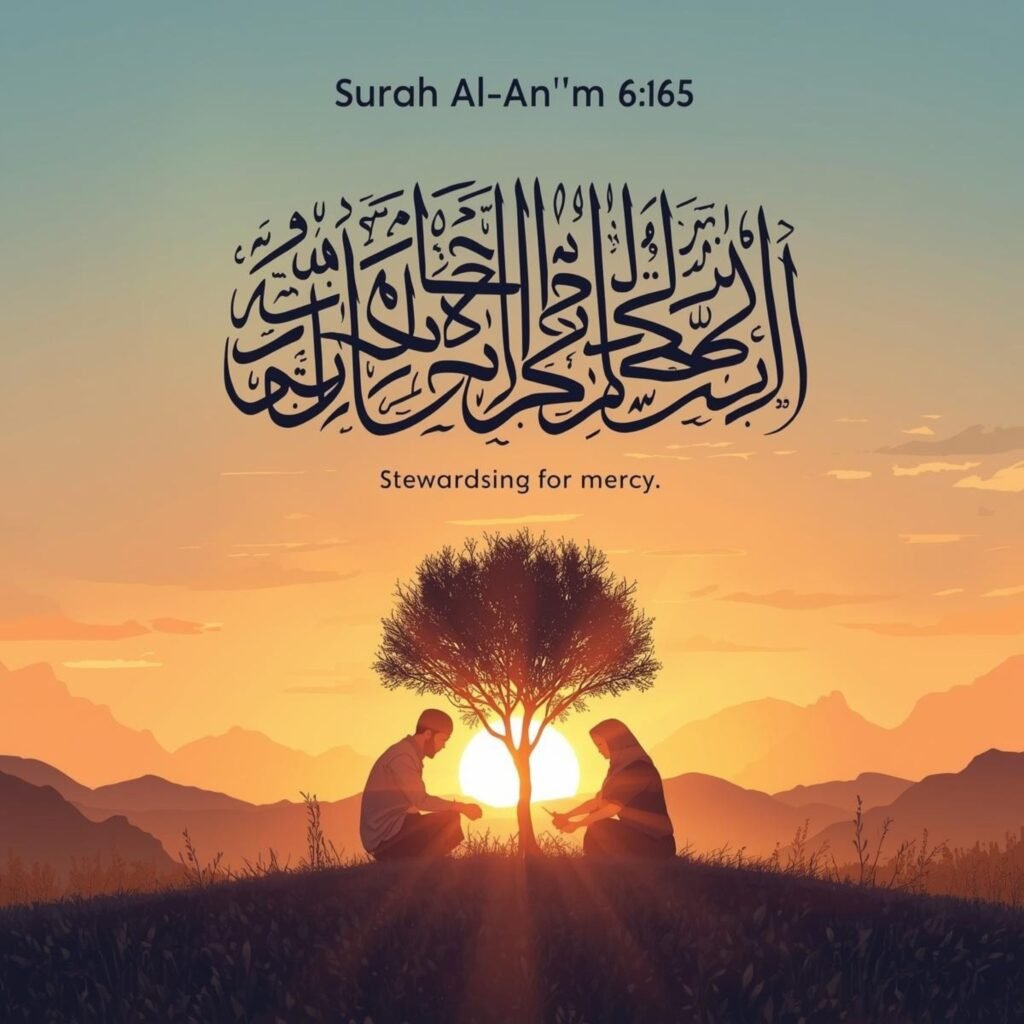
هُوَ الَّذِي جَعَلَكُمْ خَلَائِفَ فِي الْأَرْضِ
“It is He who has made you successors upon the earth.”
(Surah Al-An’ām 6:165)
Khalīfah implies a caretaker role that will have to answer to Allah about the state of His creation.
Consequently, neglect of this role is more than an ecological failure; it is a spiritual failure.
2. The Prophet Muhammad ﷺ: A Model for Ecological Mercy
The Messenger of Allah ﷺ was the best example of mercy, not just for humanity but for every living thing.
وَمَا أَرْسَلْنَاكَ إِلَّا رَحْمَةً لِّلْعَالَمِينَ
“And We have not sent you, [O Muhammad], except as a mercy to the worlds.” (Sūrat al-Anbiyā 21:107)
He said:
“If a Muslim plants a tree or sows seeds, and a bird, person, or animal eats from it, it is considered charity (sadaqah).”
(Sahih al-Bukhari)
He prohibited cutting trees when it isn’t necessary, wasting water when making wudu, and harming animals (even in warfare). He established environmental sanctuaries (Hima), or protected green zones, before the conservation movement.
This is the practical example of Islamic Stewardship & Climate Ethics, Muslims’ responsibility as Khalīfah in motion.
3. The Mīzān or Balance of Nature in Islam
Allah ﷻ created the universe in balance:
وَالسَّمَاءَ رَفَعَهَا وَوَضَعَ الْمِيزَانَ
“And the heaven He raised and imposed the balance.”
(Surah Ar-Rahman 55:7)
While Human beings can can easily do acts of greed, excess, and vanity to create an imbalance in this Mīzān. The Prophet ﷺ warned that “wastefulness is the companion of Satan.”
Thus, Islamic climate ethics encourage moderation (wasatiyyah): in consuming, producing, and living with humility and moderation.
Tasawwuf and the Heart of Environmental Awareness
1. Recognizing Allah’s Beauty in His Creation
Sufis say everything in the created world is a mirror that reflects Allah’s Names — Al-Jamīl (The Beautiful), Al-Razzāq (The Provider), Al-Latīf (The Subtle).
Imam al-Ghazali (RA) said:
“To look at the creation with love is to remember the art of the Creator.”
When a person’s heart is polished through dhikr and awareness of Allah, they will see the Divine Presence in everything, such as a wood tree will no longer simply be wood, rather, an ayah (sign) of Allah’s creative mercy.
2. The Sufi Path: Mercy to All Creation
Narrative about Shaykh Abdul Qadir Jilani (RA):
One evening, the distinguished Ghawth al-Azam (RA) saw a thirsty dog on the road. Despite his own fatigue, he gave it water from his own cup, saying:
“O Allah, if this creature dies of thirst, what will I say to You on the Day of the Resurrection?”
That night, he saw in a dream the Prophet ﷺ saying,
“O Abdul Qadir, Allah is pleased with your mercy. Continue to act for the protection of creation.”
That is being Khalīfah, mercy in action.
Narrative about Khwaja Gharib Nawaz (RA):
In Ajmer, Khwaja Sahib (RA) would say:
“Do not pluck a leaf without necessity — even that leaf praises Allah.”
He would put out food for birds before eating, believing that if you feed mercifully, even your sustenance will have barakah.
Tasawwuf reminds us that the outer environment reflects the inner environment, when the heart becomes bad, the world becomes bad as well.
Clean the heart, and the earth breathes again.
The Call of Islam to Environmental Renewal
1. Humanity’s Neglected Pact
Before the beginning of time, Allah obtained a covenant from the very souls of mankind:
أَلَسْتُ بِرَبِّكُمْ قَالُوا بَلَى
“Am I not your Lord?” They replied, ‘Yes, certainly.’”
(Surah Al-A‘raf 7:172)
To be a Khalīfah is to honor this covenant, to be responsible witnesses of Allah’s creation. Every polluted river, every forest burned, every meal wasted is a violation of this trust.
2. The Crisis of Today
Global warming, water scarcity, deforestation – these are not just physical matters; they are signs of spiritual imbalance.
“Corruption has appeared throughout Allah’s creation, both on land and sea, due to what people’s hands have earned.” (Surah Ar-Rum 30:41)
Modern consumer culture, motivated by greed and forgetfulness, is a violation of Allah’s created principle of moderation. The loss of barakah is not just in wealth, but in air, food, and even rain.
3. Reestablishing the Khalīfah Role
To restore barakah, we should go back to simplicity. You can plant a tree, save water, or care for an animal and consider it worship, provided you possess the proper intention.
As the Prophet ﷺ said:
“The Earth is green and beautiful, and Allah has made you Khalīfah.” (Sahih Muslim)
Consequently, Islamic Stewardship and Climate Ethics have to do with Muslims’ obligation as Khalīfah, that is, it is not simply about environmental activism, it is spiritual restoration.
The Islamic Declaration on Global Climate Change,
Islamic Stewardship & Climate Ethics
In 2015, a group of Muslim scholars and environmentalists came together to release the Islamic Declaration on Global Climate Change , calling on believers to remember their responsibility to the earth.
Main messages include:
- Reduce carbon footprints and waste
- Transition to renewable energy
- Live simply, as in the lifestyle of the Prophet ﷺ
- Support global cooperation toward environmental justice
This declaration reflects the Qur’anic idea that corruption on earth is a product of man’s doing, and that the path to repentance lies in righteous action.
Practical Sunnah-Based Tips for Eco-Conscious Living
- Use the water needed for ablution or for making wudu
- Plant trees as continuing charity (sadaqah jāriyah)
- Avoid food waste, and give excess food to the poor
- Treat animals with gentleness and do not harm them
- Use biodegradable materials and avoid needless plastic
- Walk or bike if you are able because simplicity is sunnah
Dua:
اللَّهُمَّ اجْعَلْنَا مِنَ الَّذِينَ يَسْتَعْمِلُونَ نِعْمَتَكَ بِالْحَقِّ وَلَا يُفْسِدُونَ فِي الْأَرْضِ
“O Allah, make us among those who use Your blessings rightly and do not spread corruption on the earth.”

Conclusion
By harming nature, we harmful our relationship with Allah.
By caring for it, we renew the bond with Allah.
Every breeze, every bird’s chirp, and every rain drop says SubhanAllah.
Join that chorus of dhikr by becoming a true Khalīfah.
May Allah make our hearts soft and fertile like dirt, and our hands like a nourishing rain.
Read more:
- All Posts
- English Blogging

7 Heart-Melting Truths About Tears in Sujood,One Step Toward Allah That Changes Everything Introduction Tears can be shed either out...

The First Step to Allah: Take One Step Toward Allah and Watch His Mercy Run to You The authentic Hadith...
Introduction In all times, when hearts distance themselves from Allah, and faith appears to be overshadowed by worldly turmoil, Allah...


